
Guide · · By the tinysamples team
Biospecimen tracking that outlasts the people who froze it.
A research biospecimen record needs a coded ID that identifies no one, the source and consent reference, collection and processing times, a freeze-thaw count, an exact location and a dated log of every step. Handling matters because it changes results: in a study of 50 donors, glucose fell by about 1.4 mg/dL for every hour blood waited before centrifugation. This guide builds that record, then says when a tracker stops being enough.
What is biospecimen tracking?
Biospecimen tracking is recording, for every specimen taken from a person, an animal or another organism, where it came from, how it was handled and where it is now. The test is simple: someone who never met the tube can say what it is, what has happened to it, and whether it is still good for the assay they have in mind.
This guide is for research collections: a lab’s own freezer, a study cohort, a small biobank. Clinical and diagnostic work carries different obligations and needs a validated system; the fork is laid out on specimen tracking. The general version of the record, for any kind of sample, is in how to keep track of lab samples.
What does a biospecimen record need?
Twelve fields in four groups, plus a log. Identity: a coded ID and the study it belongs to. Origin: a source code, the consent or protocol reference, the collection date and time, and who collected it. Handling: specimen and container type, processing times, volume and a freeze–thaw count. Storage: an exact location and a status.
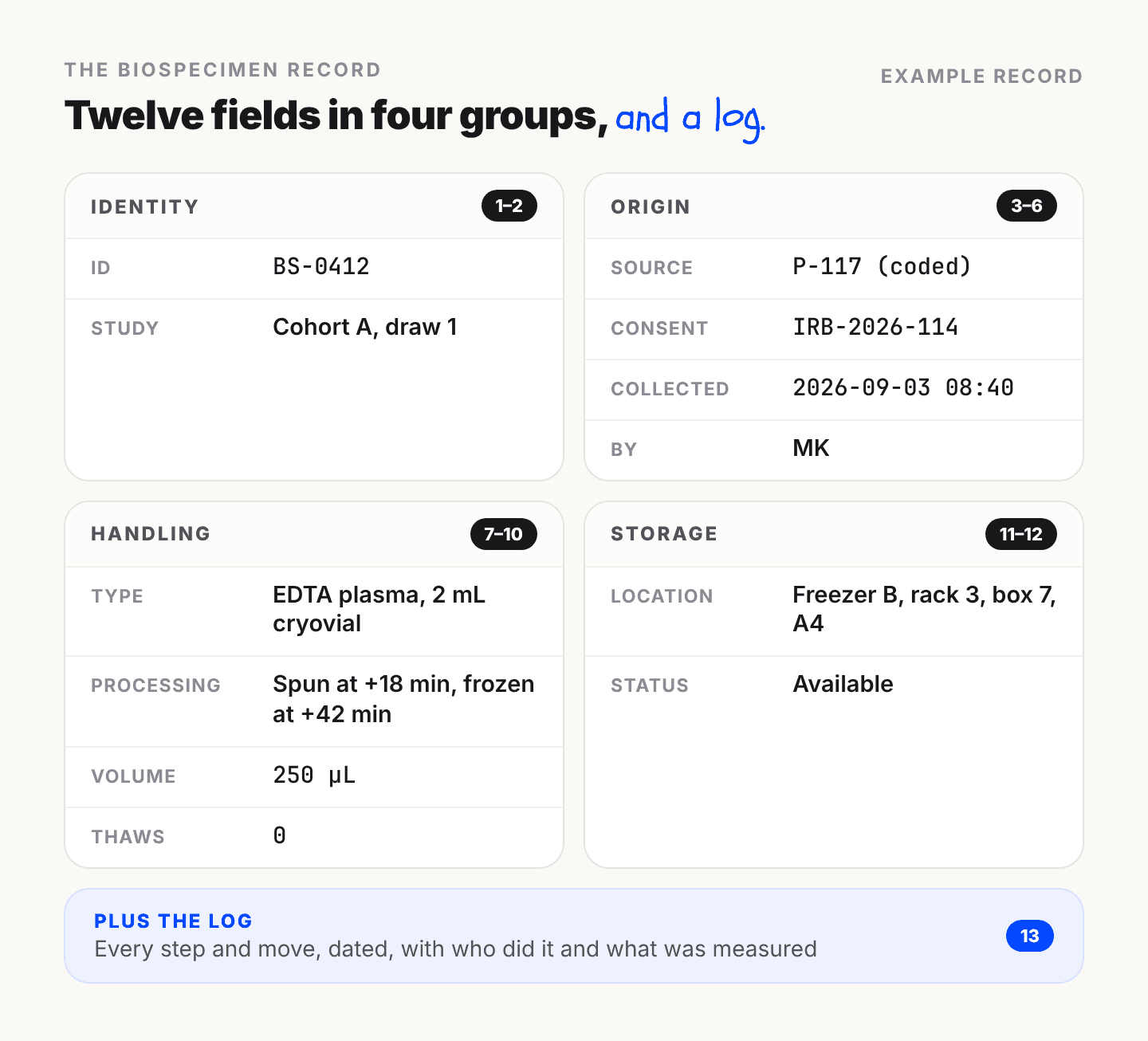
Everything under Origin is a reference, not the thing itself. The record holds a code for the source and a pointer to the consent, and the key that links the code to a person lives somewhere else, with the people who are allowed to see it.
| What to write | Why it earns its place | |
|---|---|---|
| Source code | A code for the donor or animal, not a name or a record number. | Lets you find every specimen from one source without identifying them. |
| Consent reference | The protocol or consent version the specimen was collected under. | Decides what the specimen may be used for, and by whom. |
| Collected | Date and time, as 2026-09-03 08:40. | The clock for everything that follows: time to spin, time to freeze. |
| Processing | Minutes from collection to centrifugation and to freezing, and the spin. | The pre-analytical history, which is invisible in the tube. |
| Freeze–thaw count | Starts at zero. One more every time the tube is thawed. | Tells you whether a tube is still fit for a sensitive assay. |
| Location | Freezer, rack, box and position, in that order. | The difference between a record and a search party. |
Why does handling history matter as much as the sample?
Because pre-analytical handling changes what a sample measures, and the change cannot be seen in the tube. In a study of 50 donors at the National Biobank of Korea, glucose fell by about 1.4 mg/dL for every hour blood waited before centrifugation, and GGT and LDH shifted with both the delay to processing and the delay to freezing. Only the record knows how long the wait was.
The field has a name for this. SPREC, the Standard PREanalytical Code, came out of ISBER’s Biospecimen Science Working Group as a standard way to make explicit the pre-analytical variations in the collection, preparation and storage of a specimen. It is worth a look if you plan to share samples. Few collections use it: a 2015 survey of 21 Australian cancer biobanks found low rates of recording the SPREC code.
You do not need the code to get the benefit. You need the facts written down: when it was drawn, how long it waited, how it was spun, when it was frozen, at what temperature.
How many freeze–thaw cycles can a sample take?
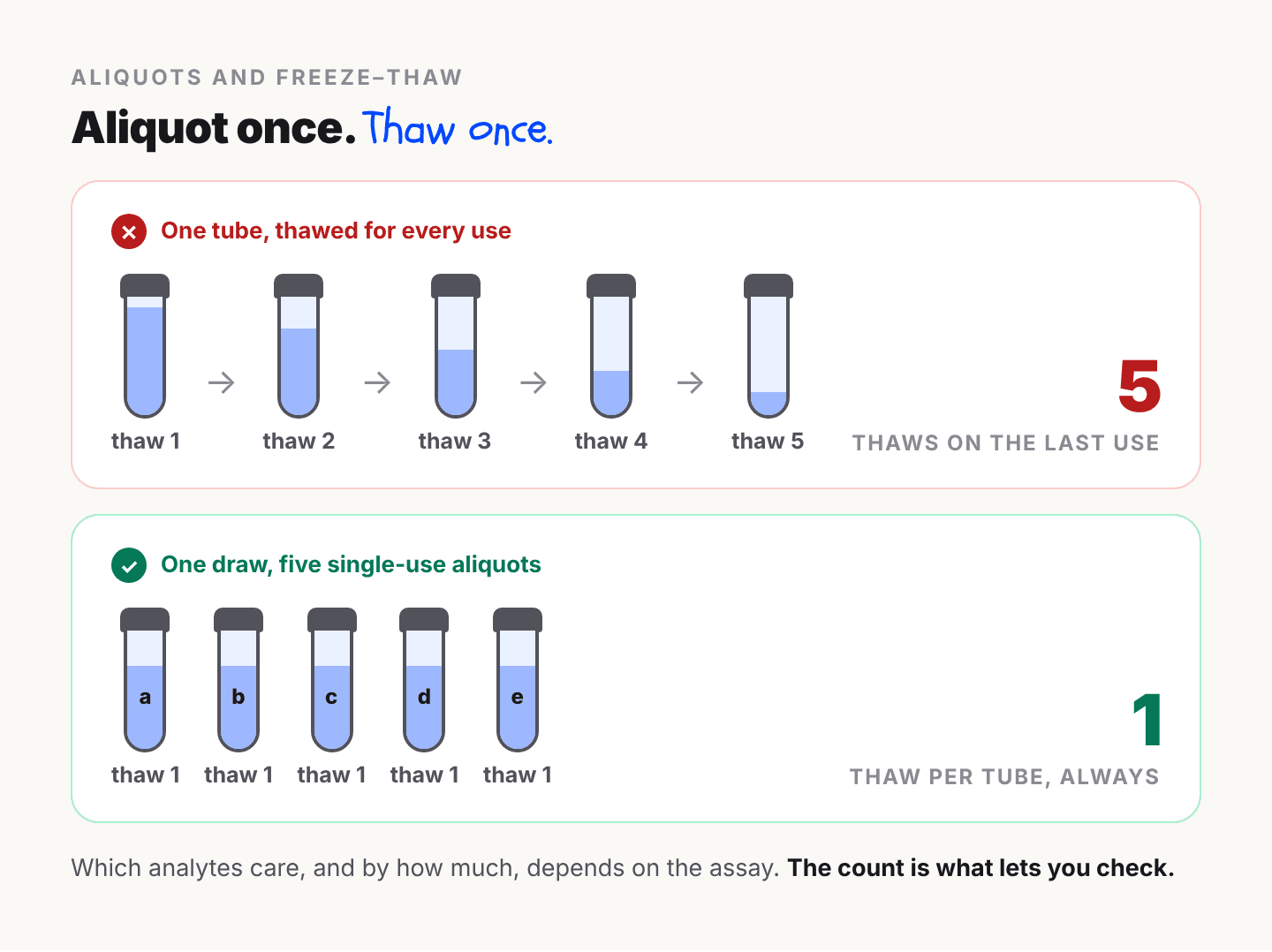
There is no universal number; it depends on the analyte. In one study of 30 plasma and serum samples, up to five freeze–thaw cycles left interferon-γ, IL-8 and VEGF-R2 unchanged, while MMP-7, TNF-α and VEGF changed significantly. MMP-7 and VEGF rose by up to about 15% in plasma and about 7% in serum. In the 50-donor study above, AST, BUN, GGT and LDH were also sensitive to repeated cycles. So count the cycles, and keep the count low.
The fix is mostly logistics. Aliquot at first processing into single-use volumes, so each tube is thawed once. Give every aliquot its own ID and its own record, and write the parent draw’s ID on each so they can be found together. When a tube does come out, record the thaw: date and time, who, how long it sat out, and how much is left.
How should you label and ID biospecimens?
With a short coded ID that identifies no one: a prefix and a counter, such as BS-0412, assigned once and never reused. It should not be built from a name, a medical record number or a date. The US de-identification rule lists all three as identifiers, and allows a re-identification code only if it is not derived from or related to information about the person.
Whether that rule binds your lab depends on your institution and your IRB, so ask them. The habit is right either way: an ID that says nothing cannot leak anything, and it cannot become wrong when the facts change. The naming guide has the formats, the characters to avoid, and what goes on a label that has to survive -80°C.
Keep the link between a code and a person in a separate place with its own access, never in the sheet or the tool the whole lab uses.
How do you track where a specimen is?
Write the location down to the cell, in one fixed order: freezer, rack, box, position. “Freezer B” finds nothing; “Freezer B, rack 3, box 7, A4” finds a tube. Update it the moment a tube moves, and treat every move, including out and back for a thaw, as an event worth a line.
Reconcile a box against the record whenever it is open, not once a year. A tube that is in the record but not the box, or in the box but not the record, is how a collection starts to drift, and it is cheapest to catch on the day.
What belongs in the log for each handoff?
Every event that could change the sample or where it is: collected, processed, aliquoted, frozen, moved, thawed, shipped, received, used up, discarded. Each with the date and time, the person’s name and anything measured. For a research collection that is custody in the plain sense. Regulated chain of custody adds signatures and a validated system, which is a different tool.
What should you check on freezing day?
Ten lines, in the order the day goes. If all ten are in the record, the tube is findable and its history is readable.
- The coded ID is on the tube, large, on a label rated for the freezer.
- The source code and the consent reference are in the record, not on the tube.
- The collection date and time are recorded.
- Minutes from collection to centrifugation are recorded, with the spin.
- Minutes from collection to freezing are recorded, with the freezer temperature.
- The specimen type and the container are recorded.
- Each aliquot has its own ID, its volume, and the parent draw’s ID.
- The location is written to the cell: freezer, rack, box, position.
- The freeze–thaw count starts at zero.
- Whoever did all of it is named, by name.
When does a tracker stop being enough?
When the work is regulated, when instruments have to write into the record, when you need enforced workflows with signatures, or when the collection is bigger than one person can reconcile. A tracker fits a research freezer. A LIMS or a biobank information system fits a regulated or institution-wide collection.
ISBER’s Best Practices (fifth edition, December 2023) are the reference for running a repository properly. They are voluntary and consensus-based, and a fair yardstick even if you never run one. The five-question LIMS test says when to move up. Until then, a spreadsheet with an owner is a fair start, and the template is free.
How does tinysamples handle biospecimens?
We sell tinysamples, a lightweight sample tracker, and this is what it does for a freezer, from the app itself. Each tube is registered and gets the next ID. A protocol’s steps record typed values: numbers with units, such as time to spin in minutes or volume in µL, and also yes or no, text, a photo or a barcode. A tube has a location, picked from places you have already used or typed fresh, and search finds it by ID, name or place.
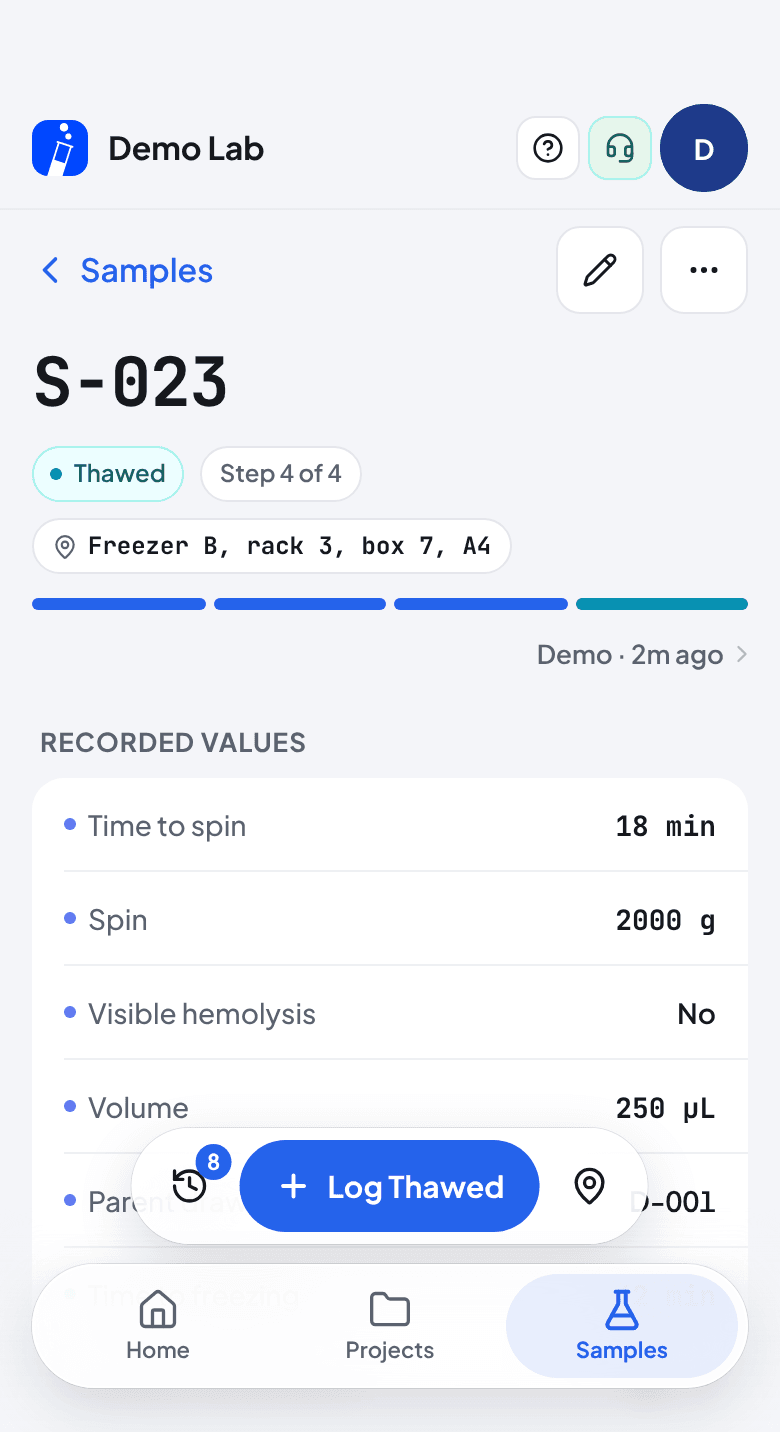
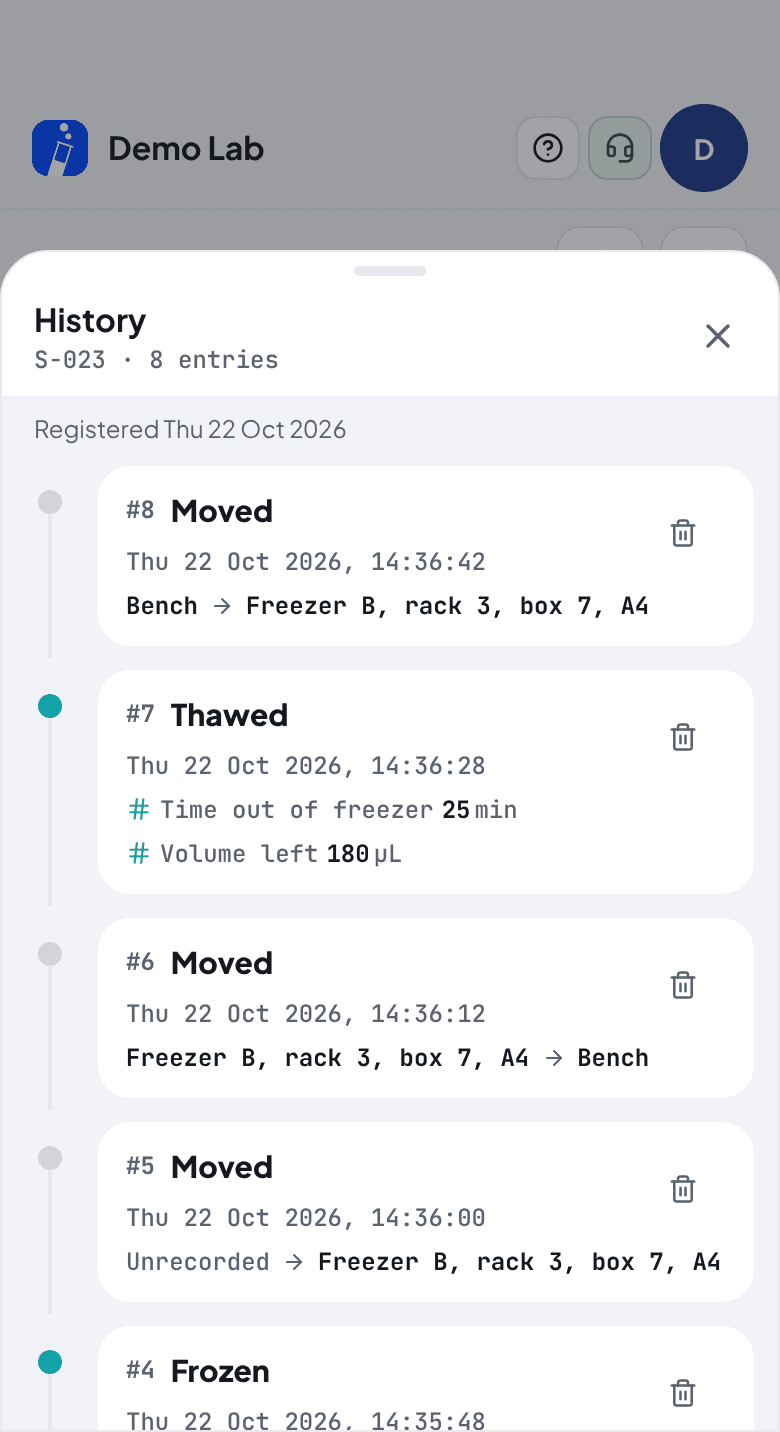
Moving one tube, or a whole selection, writes a Moved entry from where to where. Taking a tube out of the freezer and putting it back is two entries, which is your thaw trail, and a step can record how long the tube sat out and how much is left. Every entry is stamped to the second.
What it does not do: there is no freezer map or box grid, so a place is a name you type; there is no link between a parent and its aliquots, so write the parent’s ID in a value on each aliquot; there is no consent management or shipping manifest; and there are no signatures or validation package, so it is not for regulated work. A barcode value can be typed, or scanned with the camera in Chrome and Edge, but not on iPhone Safari.