
Template ·
A chain of custody form for research samples.
A chain of custody record for research samples captures, for every hand-off, which tube, who released it, who received it, when, from where to where, and the condition and temperature on arrival. Print the form below for a shipment, or keep the CSV as a running log. It is a research-lab form, not a legal or regulatory one, and this page says when you need someone else’s.
Printable chain of custody form
One page · prints from your browser or saves as a PDF · no email required
Open the printable formchain-of-custody-log.csv
CSV · 12 columns · three worked example lines · opens in Excel and Google Sheets · no email required
Download the logWhat does a chain of custody record need?
Custody is the record of who held a sample, when, and what state it was in when it changed hands. One clinical-trials piece on managing custody frames it as questions to answer for every sample: is it the right one, can it be tied back to where it came from, how often has it been frozen and thawed, did it stay at the right temperature, and did it go to the right place.
These columns are our way of answering those at each hand-off. No regulator publishes them as the required fields for a research lab, and the printable form carries the same ones.
- sample_ide.g. BS-0412-a
- The tube, by its permanent ID. A shipment of ten tubes is ten rows, one per tube.
- transfer_noe.g. 1
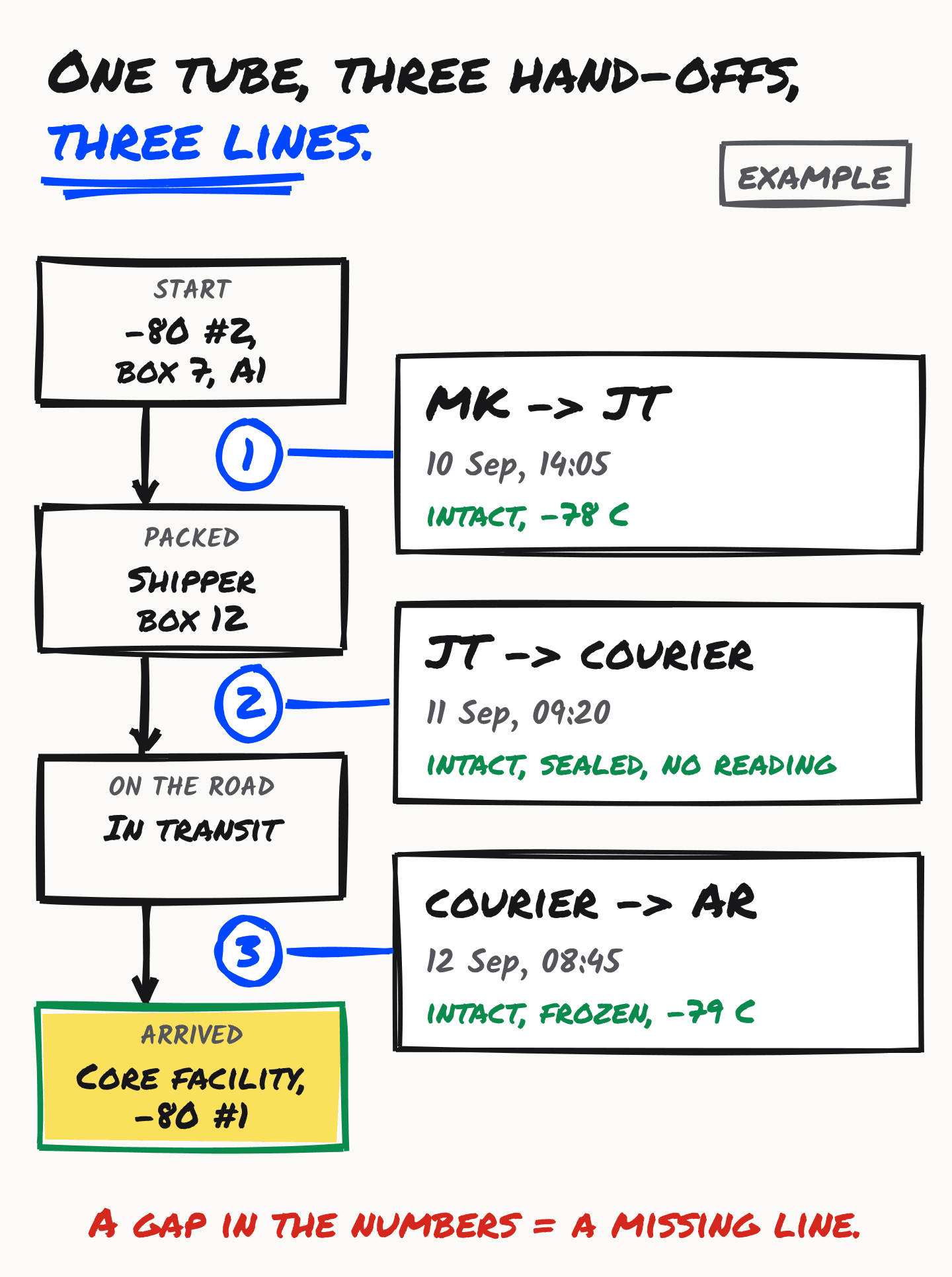
- Counts the hand-offs of this tube: 1, 2, 3. A gap in the numbers is a missing line, which is the whole point of numbering them.
- date_timee.g. 2026-09-10 14:05
- The moment of hand-off, to the minute, in the form YYYY-MM-DD HH:MM.
- released_bye.g. MK
- Who let go of it. Initials, or a name and a reference when it is not someone in your lab.
- received_bye.g. JT
- Who took it. A hand-off with no receiver is a loss, not a transfer.
- from_locatione.g. -80 #2, rack 3, box 7, A1
- Where it was, written to the same standard as your inventory.
- to_locatione.g. Shipper box 12
- Where it went. For a shipment, "In transit" until it arrives, then the receiving freezer.
- reasone.g. pack for core facility
- One short phrase. Reviewers read this column first.
- conditione.g. intact
- What the receiver saw: intact, thawed, leaking, label unreadable. Filled in by the receiver, before signing.
- temp_ce.g. -78
- Temperature on receipt in degrees Celsius, as a number. Blank when nobody could measure it, which is itself worth knowing.
- packaginge.g. dry ice, sealed
- How it travelled: dry ice, wet ice, ambient, sealed. Leave it blank when it did not leave the room.
- notese.g. seal 0093
- Carrier tracking numbers, seal numbers, anything the receiver wants on the record.
When do you need a custody form, and when is a log enough?
Use the form whenever a sample leaves your control: a shipment to a core facility or a collaborator, a hand-over to a courier, a sample arriving from another site. Use the log for hand-offs inside your own lab, where one line per move is enough.
If your samples come under a consent, an ethics approval or a sponsor agreement, check whether it names a custody record. If it does, use that one.
How do you fill it in?
- One line per tube per hand-off. A shipment of ten tubes is ten lines in the log, or ten rows on one printed form.
- The receiver writes the condition and the temperature before signing. Not after unpacking, and not from memory. “Not measured” is a legitimate entry. A blank is not.
- Number the hand-offs. A gap in the numbers is a missing line, and you will see it the first time anyone checks.
- Never fix a line. If one is wrong, add a line that says what was wrong and who noticed. The wrong line stays, because it is part of what happened.
- Keep a copy at both ends. The original travels with the shipment and the sender keeps a copy of what they released.
When is this the wrong form?
When a regulation, a sponsor or the receiving lab prescribes the form. In U.S. DOT-regulated workplace drug testing, for example, the Federal Custody and Control Form must be used to document every collection, and a non-Federal form must not (49 CFR 40.40). Regulated clinical trials and compliance testing often come with their own required paperwork too. Ask whoever will receive the sample before you ship it.
This form is for research labs keeping their own records. It carries no legal or regulatory weight, and if your work is regulated you need a validated system, as specimen tracking explains.
How does tinysamples record custody?
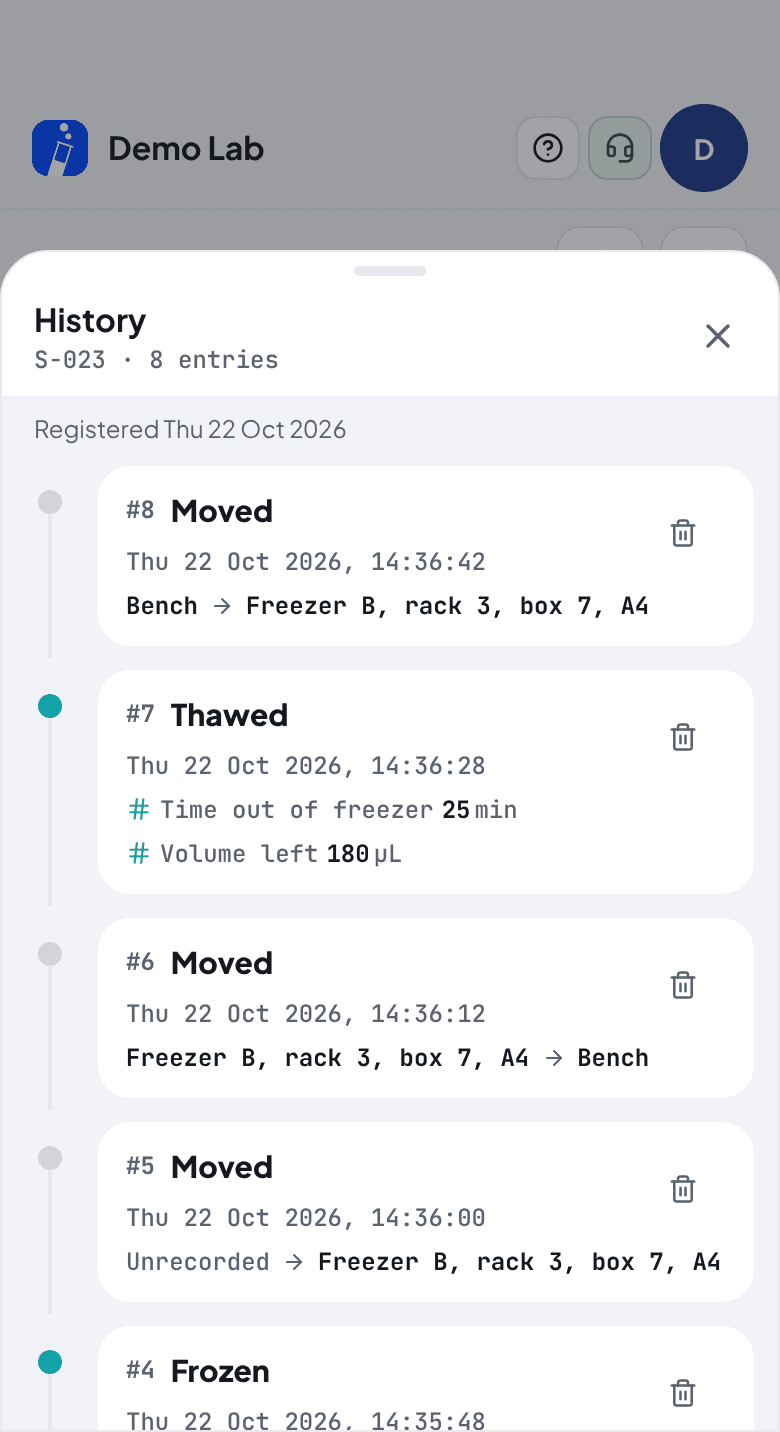
Every action on a sample is stamped with who did it and when, to the second, and a move is recorded from one place to the other. A hand-off can be a step in your protocol with its own fields, such as a Condition dropdown and a Temperature number on a Received step. A removed entry leaves a visible mark on the timeline and is written to an audit log the workspace owner can export.
What it does not do: no signatures, no step where the receiver accepts the sample, no shipping manifest or carrier tracking, and no 21 CFR Part 11 package. For a shipment that needs signatures it is the wrong record. For custody inside your lab it is a log you do not have to type.